
By Rawaid Hussain Siddiqui – Immigration-Law Specialist · LL.M. (Immigration Law), Master in Diplomacy andInternational Relations, PhD Scholar in Immigration Law
What Is EB-2 NIW?
What is EB2 NIW? EB-2 NIW, or Employment-Based Second Preference National Interest Waiver, is a self-sponsored U.S. green card pathway for qualified professionals. It allows eligible applicants to file Form I-140 without a permanent job offer or PERM labor certification if their proposed work has substantial merit and national importance under the Dhanasar framework.
EB-2 NIW stands for Employment-Based Second Preference National Interest Waiver. It is a U.S. green card pathway for qualified professionals who can show that their proposed work has substantial merit, carries national importance and that the United States would benefit from waiving the normal job offer and PERM labor certification requirements.
In ordinary EB-2 cases, a U.S. employer usually sponsors the foreign professional, completes the labor certification process through the Department of Labor, and then files Form I-140 with USCIS. EB-2 NIW changes that structure. A qualified person may file the immigrant petition independently, without needing a specific U.S. employer to sponsorthe case.
That is why EB-2 NIW is often described as a self petition green card option. It is especially relevant for researchers, engineers, physicians, entrepreneurs, public-health professionals, AI specialists, educators, sustainability experts, and other skilled professionals whose work can be framed around broader U.S. benefit. The core question goes deeper than talent alone: Does the person have a credible U.S. endeavor that can produce benefits beyond a private employer or personal career advancement?
EB-2 NIW Explained in Plain English:
EB-2 NIW has two layers.
First, the applicant must qualify for the EB-2 classification. This usually means either an advanced degree or exceptional ability in the sciences, arts, or business.
Second, the applicant must qualify for the National Interest Waiver. This means showing that the ordinary job offer and labor certification requirements should be waived because the person’s work serves the interests of the United states.
A simple way to understand it is this:
• EB-2 asks whether the applicant meets the professional qualification threshold.
• NIW asks whether the applicant’s proposed U.S. work is important enough, and the applicant is well positioned enough, to justify a waiver of the employer-sponsorship requirement.
A person can be highly educated and still fail NIW if the proposed endeavor is vague. A person can also have strong practical experience and qualify if the evidence connects their background to a serious U.S.-focused plan with measurable value.
What Does National Interest Waiver Mean?

A National Interest Waiver is a request asking USCIS to waive the normal requirement of a permanent job offer and labor certification.
In a traditional PERM-based green card case, a U.S employer must test the labor market and show that hiring the foreign worker will not negatively affect qualified U.S. workers. The NIW exists for cases where that labor market process does not fit the nature of the applicant’s work or where the U.S. benefit of the work outweighs the need for a standard employer-sponsored route.
The waiver does not mean USCIS gives a green card automatically. It means the applicant may ask USCIS to approve the immigrant petition without employer sponsorship if the evidence satisfies the legal standard. The national interest can involve many areas, including:
• public health and healthcare delivery;
• engineering, infrastructure, transportation, and energy systems;
• artificial intelligence, cybersecurity, data science, and emerging technology;
• education, disability services, workforce development, and social programs;
• entrepreneurship, job creation, economic growth, and supply-chain improvement;
• environmental protection, climate resilience, and sustainable industry;
• scientific research, applied innovation, and technology transfer.
The strongest cases usually define the national interest through a specific proposed endeavor, not through a broad profession. “I am a software engineer” is not enough. “I will develop secure AI systems for healthcare data interoperability across U.S. medical providers” is much closer to how a persuasive NIW theory is built.
Who Qualifies for EB-2 NIW?
A person may qualify for EB-2 NIW if they first meet the EB-2 classification and then satisfy the National Interest Waiver standard. In practical terms, the applicant needs both a qualifying professional background and a credible U.S.-focused endeavor that USCIS can evaluate under the three Dhanasar prongs.
EB-2 NIW eligibility checklist:
• Advanced degree, bachelor’s plus five progressive years, or exceptional-ability evidence;
• specific proposed U.S. endeavor;
• evidence that the endeavor has substantial merit and broader U.S. importance;
• proof that the applicant is well positioned to advance the work;
• persuasive reason why the job offer and PERM labor certification should be waived.
The typical qualification profile includes one of the following:
• a U.S. master’s degree or higher, or a foreign equivalent;
• a U.S. bachelor’s degree or foreign equivalent plus at least five years of progressive post-baccalaureate experience in the specialty;
• exceptional ability in the sciences, arts, or business, supported by regulatory evidence.
However, the EB-2 threshold is only the starting point. USCIS then reviews the applicant’s proposed endeavor, past record, current progress, evidence of impact, and whether waiving the labor certification requirement would benefit the United States. A strong candidate is usually able to explain:
1. what they will do in the United States;
2. why the work matters beyond one employer;
3. how their past achievements support their ability to execute the plan;
4. what evidence shows market, institutional, professional, or public need;
5. why the ordinary PERM route does not properly capture the value of their work.
EB-2 NIW Eligibility Requirements Explained:
1. Advanced Degree Route:
An advanced degree generally means a U.S. academic or professional degree above a bachelor’s degree, or a foreign equivalent. A master’s degree, Ph.D., M.D., or equivalent professional qualification may satisfy this route if the credential evaluation supports U.S. equivalency. A bachelor’s degree plus five years of progressive post-baccalaureate experience may also count as the equivalent of an advanced degree. The experience should show increased responsibility, skill depth, and relevance to the specialty.
A frequent mistake is assuming that any long career automatically equals advanced degree equivalency. The experience must be progressive and tied to the field connected to the proposed U.S. work.
2. Exceptional Ability Route:
Applicants who do not fit the advanced degree route may still qualify by showing exceptional ability in the sciences, arts, or business. This is a higher-than-average level of expertise. It is not the same as EB-1A extraordinary ability, but it still requires objective proof. Common evidence may include:
• academic records related to the area of ability;
• letters showing at least ten years of full-time experience;
• a professional license or certification, where relevant;
• evidence of high salary or remuneration compared with others in the field;
• membership in professional associations;
• recognition for achievements and significant contributions.
Meeting three listed criteria may not be enough if the overall record does not show a level of expertise above the ordinary. USCIS reviews the evidence as a whole.
3. The Proposed Endeavor:
The proposed endeavor is the specific work the applicant plans to advance in the United States. It should be concrete, realistic, and connected to national-level benefit. A strong proposed endeavor usually includes:
• the field or problem being addressed;
• the applicant’s role;
• the intended U.S. beneficiaries;
• the expected practical outputs;
• a credible implementation plan;
• evidence showing why the work matters.
Weak endeavors sound like job descriptions. Strong endeavors sound like organized plans capable of producing broader value.
4. Evidence of Positioning:
USCIS does not require guaranteed success. It does require evidence that the applicant is well positioned to
advance the proposed work.
This can include education, technical skills, leadership experience, prior projects, publications, patents, citations,
media coverage, contracts, professional letters, implementation records, business plans, pilot results, clients,
investors, institutional interest, or other proof tied to the endeavor.
The key is relevance. Evidence should not be added only to increase volume. It should help USCIS understand why
this applicant is credible for this endeavor. nderstanding the Dhanasar Framewor
Understanding the Dhanasar Framework:
USCIS evaluates National Interest Waiver cases under the three-part framework from Matter of Dhanasar, the AAO precedent decision that replaced the older NYSDOT approach. The framework asks whether the work matters, AGS Welt US | EB-2 NIW Article Package | AI-Era/YMYL Updated Publication draft – verify official USCIS/DOS sources before filing decisions whether the applicant is credible for the work, and whether the United States benefits from waiving the usual employer-sponsored process.
Dhanasar framework at a glance:
• Prong 1: The proposed endeavor has substantial merit and national importance.
• Prong 2: The applicant is well positioned to advance the proposed endeavor.
• Prong 3: On balance, it benefits the United States to waive the job offer and labor certification requirements.
Prong 1: Substantial Merit and National Importance
The first prong asks whether the proposed endeavor has substantial merit and national importance. Substantial merit means the work has real value. It may have scientific, economic, educational, cultural, health-related, technological, environmental, or entrepreneurial merit. National importance means the potential impact is broader than a private benefit to one applicant or one employer.USCIS looks at prospective impact. The work may be national in scale, or it may have broader implications even if implemented regionally or through a focused platform, product, research program, service model, or business plan.
For example:
• A physician proposing to expand clinical access in underserved U.S. communities may have a national-interest argument.
• A cybersecurity specialist building tools for critical infrastructure protection may connect the endeavor to national security and economic continuity.
• An education specialist improving special education implementation across school systems may frame the work around public education outcomes and disability-service consistency.
• A founder building a scalable manufacturing process that strengthens U.S. supply-chain resilience may present
economic and industrial significance.
The strongest Prong 1 sections avoid generic claims. They use evidence, policy context, data, and practical explanation.
Prong 2: Well Positioned to Advance the Endeavor
The second prong focuses on the applicant. USCIS considers whether the person has the education, skills, knowledge, record of success, future plan, progress, and outside interest needed to move the endeavor forward. This does not mean the applicant must already be famous. It means the applicant’s record must make the proposed plan believable. Useful evidence may include:
• advanced education or specialized training;
• project leadership and measurable results;
• research output, citations, patents, or technical publications;
• contracts, client letters, implementation records, or pilot work;
• professional licenses, memberships, or certifications;
• recommendation letters explaining specific contributions;
• a business or professional plan with realistic steps;
• stakeholder interest from users, institutions, employers, customers, investors, or public-sector partners.
A common weakness is submitting letters that praise the applicant but do not connect the applicant to the proposed endeavor. Strong letters explain what the applicant did, why it mattered, and why the person is likely to advance the future work.
Prong 3: On Balance, Beneficial to Waive the Job Offer and Labor Certification
The third prong asks whether, considering the record as a whole, the United States would benefit from waiving the job offer and labor certification requirements. This is a balancing analysis. It does not require the applicant to prove that no qualified U.S. worker exists. It also does not require proving harm if the waiver is denied. The better argument is that the applicant’s work, qualifications, and proposed contribution make the waiver a practical fit AGS Welt US | EB-2 NIW Article Package | AI-Era/YMYL Updated Publication draft – verify official USCIS/DOS sources before filing decisions
• the endeavor is independent, entrepreneurial, research-driven, or cross-institutional;
• the work does not fit neatly into one permanent employer’s job offer;
• the applicant’s contribution would benefit the United States even if other qualified workers exist;
• the work addresses an urgent or high-priority U.S. problem;
• the applicant’s plan may generate economic, scientific, educational, health, or infrastructure benefit;
• requiring a labor certification could delay or limit the proposed contribution.
Prong 3 is often where a petition becomes strategic. The argument should explain why self-sponsored advancement of the endeavor makes sense in practical terms.
Benefits of EB-2 NIW Compared to Other Immigration Pathways:
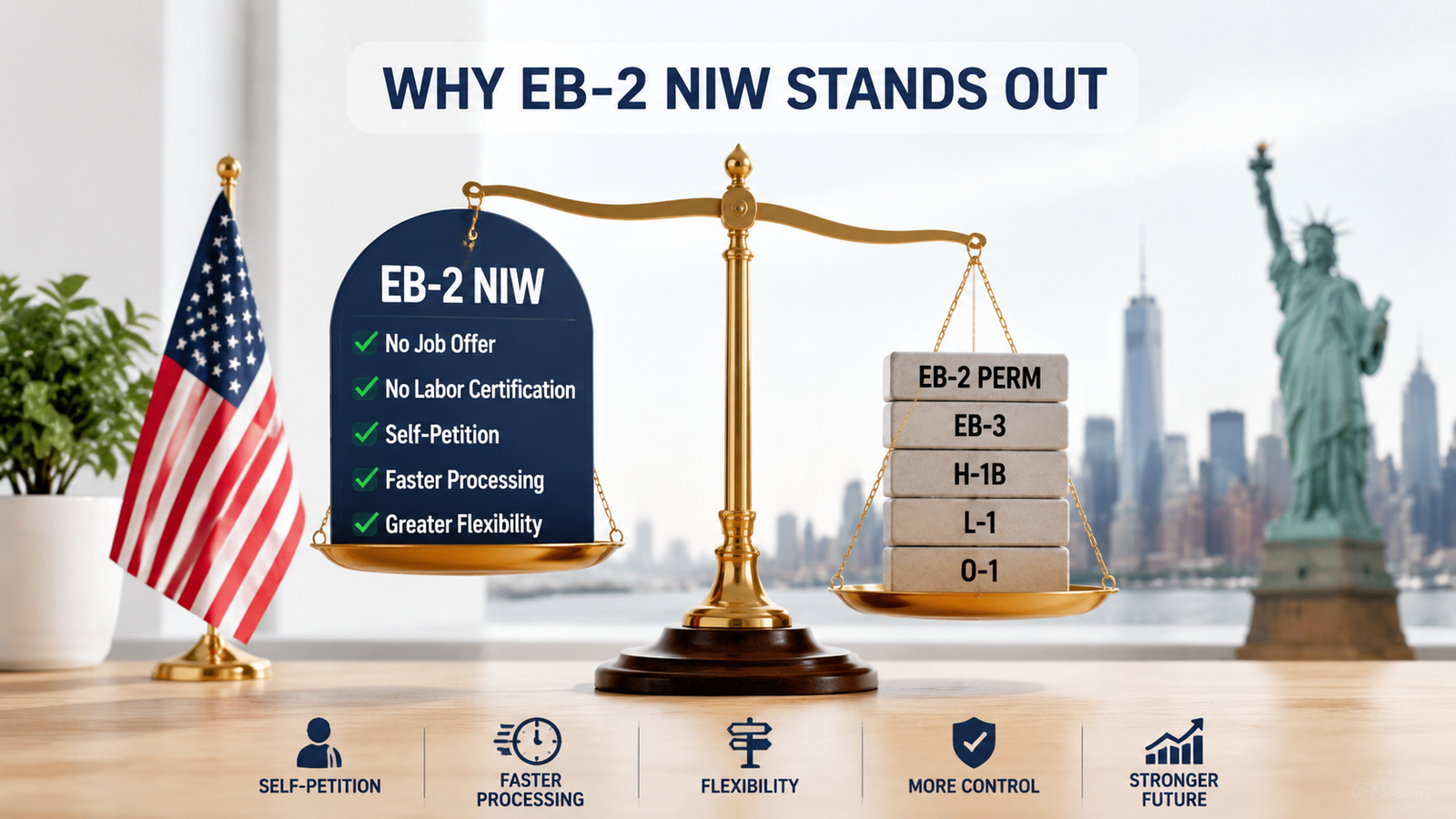
1EB-2 NIW is attractive because it gives qualified professionals more control over their immigration strategy. The main benefits include:
• No permanent job offer required. The applicant can self-petition.
• No PERM labor certification required. This removes the Department of Labor recruitment stage.
• Flexible professional path. The endeavor may involve research, entrepreneurship, consulting, implementation,policy work, product development, or a specialized professional plan.
• Useful for applicants outside the United States. A person may file Form I-140 from abroad, then proceed through consular processing when eligible.
• Suitable for founders and independent experts. Applicants do not need a traditional employer if the evidence supports the endeavor.
• Potentially compatible with other strategies. Some applicants may pursue EB-2 NIW alongside EB-1A, O-1, or employer-sponsored options when legally appropriate.
EB-2 NIW is not the fastest route for every person. Country of birth, Visa Bulletin movement, current status, evidence strength, and long-term goals matter.
The EB-2 NIW process starts with confirming the EB-2 threshold, defining the proposed endeavor, building evidence, preparing the I-140 petition, and then waiting for visa availability before adjustment of status or consular processing. Premium processing may speed the I-140 decision, but it does not remove Visa Bulletin backlogs.
Process summary:
1. Confirm EB-2 eligibility.
2. Define the proposed U.S. endeavor.
3. Build evidence for the applicant, endeavor, and national need.
4. Prepare the petition letter and exhibits.
5. File Form I-140 with USCIS.
6. Consider premium processing where appropriate.
7. Monitor Visa Bulletin availability.
8. Complete adjustment of status or consular processing when eligible.
Step 1: Confirm EB-2 Eligibility:
Before building the NIW argument, confirm whether the applicant qualifies as an advanced degree professional or a person of exceptional ability. Foreign degrees should be evaluated carefully.
Step 2: Define the Proposed Endeavor:
The proposed endeavor should be specific enough for USCIS to understand what the applicant will do, whobenefits, and why the work has broader U.S. value.AGS Welt US | EB-2 NIW Article Package | AI-Era/YMYL UpdatedPublication draft – verify official USCIS/DOS sources before filing decisions
Step 3: Build the Evidence Strategy:
A strong petition usually includes a mix of personal evidence, endeavor evidence, and national-interest evidence.This may include credentials, work records, publications, citations, project documentation, implementation proof,recommendation letters, policy references, market data, and a professional plan.
Step 4: Prepare the Petition Letter:
The petition letter should explain the legal theory clearly. It should not be a biography. It should connect theapplicant’s background, proposed endeavor, and supporting evidence to the three Dhanasar prongs.
Step 5: File Form I-140:
The EB-2 NIW petition is filed on Form I-140 with the required filing fees and supporting documentation. Current USCIS instructions and fee schedules should be checked before filing because fee rules and form requirements can change.
Step 6: Consider Premium Processing:
Premium processing is available for EB-2 NIW I-140 petitions. As of March 1, 2026, the premium processing fee forForm I-140 increased to $2,965, and EB-2 NIW premium processing provides a 45-business-day USCIS action window. Premium processing accelerates the I-140 decision stage. It does not make a visa number available faster, does notmove the Visa Bulletin, and does not shorten the final green card stage if the applicant is backlogged.
Step 7: Wait for Visa Availability:
After I-140 approval, the applicant must have a current priority date before receiving the green card through adjustment of status or consular processing. The monthly Visa Bulletin controls this stage.For June 2026, EB-2 is current for All Chargeability Areas, Mexico, and the Philippines, while China and India remainsubject to cutoff dates. USCIS also requires employment-based adjustment applicants to use the Final Action Dateschart for June 2026.
Step 8: Complete Adjustment of Status or Consular Processing:
Applicants in the United States may file Form I-485 when eligible. Applicants abroad generally proceed through theNational Visa Center and a U.S. consulate when a visa number is available and no country-specific restriction blocks issuance. Consular-stage planning became especially important in 2026 because the Department of State paused immigrant visa issuance for nationals of a listed group of countries effective January 21, 2026. This does not cancel an approved I-140, but it can affect immigrant visa issuance for affected nationals using consular processing.
EB-2 NIW Timeline: What Applicants Should Understand:
The EB-2 NIW timeline has three separate parts.
First, USCIS reviews the I-140 petition. Standard processing varies by service center and workload. Premium processing can shorten this stage to a 45-business-day USCIS action window.
Second, the applicant waits for a current priority date if the EB-2 category is backlogged for their country of chargeability. This is often the most important timeline issue for India and China.
Third, the applicant completes adjustment of status or consular processing. This final stage depends on visa availability, background checks, documentation, interview scheduling, and government workload.
A realistic timeline discussion should separate these stages. Many applicants focus only on I-140 approval, but approval alone is not the same as receiving a green card.
Current 2026 Visa Bulletin and Filing Considerations
As of the June 2026 Visa Bulletin, EB-2 Final Action Dates show:
EB-2 Chargeability Area | June 2026 Final Action Date |
All Chargeability Areas Except Listed | Current |
China-mainland born | September 1, 2021 |
India | September 1, 2013 |
Mexico | Current |
Philippines | Current |
The State Department also announced that the India EB-2 per-country limit for FY 2026 had been reached, meaning no further immigrant visas may be issued in that category for the remainder of the fiscal year, with annual limits resetting on October 1, 2026.
For applicants from India, this makes strategy especially important. EB-2 NIW may still be valuable for obtaining a priority date and building long-term flexibility, but the final green card timeline can be significantly longer than for applicants from most other countries.
Common Misconceptions About EB-2 NIW:
Misconception 1: “A Ph.D. automatically qualifies.”
A Ph.D. may help establish EB-2 eligibility and strengthen positioning, but it does not automatically satisfy the NIW standard. USCIS still reviews the proposed endeavor and the three Dhanasar prongs.
Misconception 2: “Publications and citations are mandatory.”
Publications and citations can help, especially in research-heavy cases. They are not mandatory for every profile. Entrepreneurs, engineers, healthcare professionals, educators, and industry specialists may rely on other forms of evidence.
Misconception 3: “A good job title is enough.”
A title alone rarely proves national importance. USCIS looks at what the applicant has done, what they plan to do, and why the work matters beyond the employer’s internal needs.
Misconception 4: “NIW means no need for a future plan.”
The future plan is central. EB-2 NIW is endeavor-based. A petition should explain the applicant’s intended U.S. work with enough detail to make the national-interest argument credible.
Misconception 5: “Premium processing improves the chance of approval.”
Premium processing affects speed, not eligibility. A weak petition can receive a faster RFE or denial. A strong case should be ready before premium processing is requested
EB-2 NIW for Engineers, Researchers, Entrepreneurs, and Other Professionals:
Engineers
Engineers may qualify when their work addresses U.S. infrastructure, manufacturing, energy, transportation, aviation, healthcare technology, defense-related systems, cybersecurity, environmental resilience, or supply-chain reliability.
The petition should explain specific technical contributions and connect them to broader U.S. needs. Project evidence, implementation records, technical leadership, patents, designs, safety improvements, cost savings, performance metrics, and recommendation letters can be useful.
Researchers and Scientists
Researchers often have strong NIW potential when their work contributes to public health, national security, scientific advancement, environmental systems, AI, materials science, biotechnology, or other high-priority fields.
Evidence may include publications, citations, peer review, grants, conference presentations, collaborations, independent expert letters, and practical application of research.
Physicians and Healthcare Professionals
Healthcare professionals may qualify when their work improves access, clinical outcomes, healthcare delivery, medical technology, underserved-area service, public-health response, or medical education.
A physician NIW has its own specific route in certain underserved-service contexts, but many healthcare professionals may also develop broader NIW cases based on innovation, implementation, or public-health value.
Entrepreneurs and Founders
Entrepreneurs can apply for EB-2 NIW if they meet the EB-2 threshold and show that the proposed venture has broader U.S. significance.
Useful evidence may include a business plan, market validation, revenue, pilot results, job-creation projections, investor interest, customer letters, partnerships, intellectual property, regulatory progress, and proof that the founder is central to execution.
The argument should avoid unsupported claims. USCIS responds better to realistic business evidence than exaggerated projections.
Software Engineers, AI Specialists, and Technology Professionals
Software and AI professionals can build strong cases when the work addresses a serious U.S. need, such as healthcare technology, cybersecurity, defense, critical infrastructure, education access, fraud prevention, logistics, manufacturing, financial compliance, or public-sector modernization.
A generic software-development profile is usually weak. A specific endeavor with technical depth, implementation evidence, user impact, and market or institutional relevance is much stronger.
EB-2 NIW vs EB-1A vs PERM Labor Certification:
Feature | EB-2 NIW | EB-1A | PERM-Based EB-2/EB-3 |
Sponsorship | Self-petition allowed | Self-petition allowed | Employer required |
Labor certification | Waived if NIW approved | Not required | Usually required |
Main legal focus | Proposed endeavor and national-interest waiver | Sustained acclaim and top-level recognition | Job offer and labor market test |
Education requirement | Advanced degree or exceptional ability | No fixed degree requirement | Depends on job and category |
Evidence focus | Future endeavor plus past record | Past achievements and recognition | Employer recruitment and job requirements |
Good fit for | Researchers, founders, STEM professionals, applied experts | Highly recognized leaders in the field | Employer-sponsored employees |
Premium processing | Available; 45 business days for NIW I-140 action | Available; generally faster window than NIW | Available for eligible I-140 categories |
Visa Bulletin issue | EB-2 backlogs can affect India and China | EB-1 may be more favorable for some countries, but backlogs can still occur | Depends on category and country |
Many applicants compare EB2 NIW vs EB1A because both can allow self-petitioning. EB-1A usually requires a stronger record of recognition and acclaim. EB-2 NIW can be more accessible for accomplished professionals who can frame a serious U.S. endeavor, but EB-2 backlogs may be a major planning issue for India-born applicants.
EB-2 NIW vs H-1B Sponsorship and O-1 Visa:
EB-2 NIW is an immigrant petition pathway. H-1B and O-1 are temporary nonimmigrant work visa categories.
H-1B usually requires employer sponsorship and is tied to a specific job. O-1 is for individuals with extraordinary ability or achievement and also usually depends on an employer or agent structure. EB-2 NIW can support permanent residence and can be self-filed, but it requires a strong immigrant petition and visa availability.
A person may use H-1B or O-1 status while pursuing EB-2 NIW, depending on their circumstances. The right strategy depends on timing, status maintenance, country of chargeability, and evidence strength.
Common Reasons EB-2 NIW Petitions Fail:
1. The Proposed Endeavor Is Too Vague
USCIS cannot approve a national-interest argument if the proposed work is unclear. “I will work in my field” is not enough. The petition should describe a specific plan and its intended impact.
2. National Importance Is Treated Like Personal Importance
A strong resume does not automatically prove that the endeavor matters nationally. The petition must connect the work to broader U.S. outcomes.
3. The Evidence Is Not Organized Around the Three Prongs
Submitting many documents without a clear legal structure can weaken the case. Evidence should be mapped to the Dhanasar framework.
4. Recommendation Letters Are Generic
Letters should do more than praise the applicant. Strong letters explain specific achievements, independent significance, and why the applicant is positioned to advance the endeavor.
5. The Business Plan Is Unsupported
For entrepreneurs, a business plan without market evidence, execution steps, financial logic, customer validation, or founder-specific credibility may not carry enough weight.
6. EB-2 Eligibility Is Assumed
Some cases fail before the NIW analysis because the applicant did not clearly establish advanced degree equivalency or exceptional ability.
7. The Petition Overstates the Case
Exaggerated claims can reduce credibility. It is better to present a measured, evidence-based argument that clearly explains the applicant’s real value.
How to Build a Strong EB-2 NIW Case:
A strong EB-2 NIW petition usually includes five layers.
Layer 1: Clear Endeavor Theory
The petition should define the proposed U.S. work in one clear paragraph. If the reader cannot explain the endeavor after reading the opening section, the case needs refinement.
Layer 2: National-Need Evidence
Use government reports, policy priorities, industry data, scientific literature, workforce shortage evidence, market reports, or credible institutional sources to show why the problem matters.
Layer 3: Applicant-Specific Proof
Document the applicant’s education, experience, technical skills, leadership, projects, publications, products, patents, awards, service, training, implementations, or measurable results.
Layer 4: Execution Plan
USCIS does not require certainty, but the plan should be realistic. Include phases, target users or institutions, expected outputs, partnerships, funding logic, and measurable goals where possible.
Layer 5: Legal Framing
The petition letter should connect evidence to the three Dhanasar prongs. The legal argument should be direct, organized, and specific to the applicant.
What Evidence Usually Helps an EB-2 NIW Petition?
Useful evidence depends on the profile, but common categories include:
- degree certificates and credential evaluations;
- experience letters showing progressive responsibility;
- professional licenses and certifications;
- publications, citations, patents, or technical reports;
- project records, implementation results, or product documentation;
- contracts, client letters, user adoption, pilot programs, or stakeholder interest;
- recommendation letters from credible experts;
- awards, media, speaking engagements, or professional memberships;
- business plan, financial model, market evidence, or investor/customer interest;
- national-need evidence from credible public or industry sources.
The evidence should be curated. More pages do not always mean a stronger petition. The best cases are organized around a persuasive theory
EB-2 NIW for Applicants from India, Pakistan, Brazil, Nigeria, and Germany:
EB-2 NIW eligibility rules are the same regardless of nationality, but timing and processing strategy can differ.
Applicants chargeable to India and China often face longer EB-2 Visa Bulletin waits. This makes early priority-date strategy important. Some applicants may also consider whether EB-1A is realistic based on their record.
Applicants from Pakistan, Brazil, Nigeria, Germany, and many other countries may face different practical issues, including consular processing rules, credential evaluation, documentation availability, country-specific visa restrictions, or maintaining lawful status if already in the United States.
In 2026, nationals of certain countries also need to consider Department of State immigrant visa issuance restrictions if they plan to complete the process through a U.S. consulate. This issue is separate from I-140 approval and should be reviewed before choosing a filing and travel strategy.
Why Many Professionals Choose Self-Sponsored Immigration
Many professionals choose EB-2 NIW because it allows them to build an immigration strategy around their own work, without relying entirely on a single employer’s sponsorship decision.
This matters for:
- researchers moving between universities or labs;
- founders building companies;
- consultants and independent experts;
- professionals whose work crosses sectors;
- specialists serving public-interest needs;
- applicants outside the United States seeking a direct immigrant petition path;
- H-1B workers who want a long-term strategy less dependent on one employer.
The main advantage is control. The main challenge is evidence. Without an employer’s PERM process, the applicant must make a well-documented case that the proposed work and personal qualifications justify the waiver.
Quick Qualification Summary:
EB-2 NIW may be worth evaluating if you can answer “yes” to most of these questions:
- Do you have an advanced degree, bachelor’s plus five progressive years, or strong exceptional-ability evidence?
- Can you describe a specific U.S. endeavor in one clear paragraph?
- Does your work address a broader U.S. need or priority?
- Do you have evidence that you are capable of advancing the endeavor?
- Can you show past achievements, progress, or outside interest connected to the work?
- Would your work make sense outside one fixed employer-sponsored position?
- Are you prepared to document the case with credible records, with personal statements used as support?
If the answer is yes, an EB-2 NIW profile evaluation may help determine the best petition theory.
FAQ: EB-2 NIW National Interest Waiver Green Card
What is EB-2 NIW?
EB-2 NIW is a U.S. employment-based green card pathway for qualified professionals whose proposed work benefits the national interest. It allows eligible applicants to request a waiver of the job offer and labor certification requirements and file Form I-140 without employer sponsorship.
What is National Interest Waiver?
A National Interest Waiver is a request to USCIS to waive the normal EB-2 job offer and PERM labor certification requirement because the applicant’s proposed work provides meaningful benefit to the United States
Who qualifies for EB-2 NIW?
A person may qualify if they meet EB-2 eligibility through an advanced degree or exceptional ability and satisfy the three Dhanasar prongs: substantial merit and national importance, being well positioned to advance the endeavor, and showing that the waiver benefits the United States.
Can I apply for EB-2 NIW myself?
Yes. EB-2 NIW allows self-petitioning. A qualified applicant may file Form I-140 without a U.S. employer sponsor, as long as the petition includes strong evidence supporting EB-2 eligibility and the National Interest Waiver.
Can I apply for EB-2 NIW without a Ph.D.?
Yes. A Ph.D. is not required. Applicants may qualify with a master’s degree, a bachelor’s plus five years of progressive experience, or exceptional ability. The strength of the proposed endeavor and supporting evidence is often more important than the title of the degree.
Can I apply for EB-2 NIW without publications?
professionals, entrepreneurs, engineers, healthcare workers, and consultants may rely on projects, implementation records, patents, business evidence, expert letters, or other proof. Yes. Publications are helpful in research cases, but they are not mandatory for every applicant. Industry
Is EB-2 NIW possible without citations?
Yes. Citations can support research impact, but many strong NIW cases are built on applied professional evidence. The key is showing substantial merit, broader U.S. relevance, and the applicant’s ability to advance the proposed work.
Does EB-2 NIW require employer sponsorship?
No. EB-2 NIW permits self-petitioning and waives the job offer and labor certification requirements if USCIS agrees that the case satisfies the National Interest Waiver standard.
Is EB-2 NIW better than H-1B sponsorship?
It depends. H-1B is temporary and employer-sponsored. EB-2 NIW is an immigrant petition that can support permanent residence and self-petitioning. However, EB-2 NIW requires strong evidence and can be affected by Visa Bulletin backlogs.
Can entrepreneurs apply for EB-2 NIW?
Yes. Entrepreneurs may qualify if they meet EB-2 eligibility and show that their venture has substantial merit, national importance, credible execution potential, and broader U.S. benefit such as job creation, innovation, supply-chain value, or public-interest impact.
Can software engineers qualify for EB-2 NIW?
Yes. Software engineers can qualify when their work addresses a broader U.S. need, such as cybersecurity, AI safety, healthcare systems, financial compliance, infrastructure, education technology, or public-sector modernization. A generic coding job is usually not enough.
Can international students apply for EB-2 NIW?
Yes. International students may apply if they meet EB-2 eligibility and can provide sufficient evidence for the NIW standard. However, immigration status, timing, travel, and intent issues should be reviewed carefully before filing.
Can I apply while living outside the United States?
Yes. EB-2 NIW can be filed from outside the United States. If the I-140 is approved and a visa number is available, the applicant usually completes immigrant visa processing through a U.S. consulate, subject to applicable restrictions.
.
Is premium processing available for EB-2 NIW?
Yes. Premium processing is available for EB-2 NIW I-140 petitions. As of March 1, 2026, the premium processing fee for Form I-140 is $2,965, and the NIW premium-processing action window is 45 business days.
What happens if my EB-2 NIW gets denied?
A denial does not automatically prevent future filings. Depending on the reason, an applicant may consider a motion, appeal, refiling with stronger evidence, a different endeavor strategy, employer sponsorship, O-1, EB-1A, or another route.
Can I file EB-2 NIW and EB-1A together?
Yes, some applicants file both if they have evidence supporting each category. EB-2 NIW focuses on the proposed endeavor and national-interest waiver. EB-1A focuses on extraordinary ability and sustained acclaim. The strategies should be prepared separately.
How hard is EB-2 NIW approval?
EB-2 NIW can be difficult because USCIS reviews both qualifications and the national-interest waiver. Strong cases are specific, evidence-based, and well organized. Weak cases often fail because the endeavor is vague or the evidence is not tied to the Dhanasar framework.
How long does EB-2 NIW take?
The timeline depends on I-140 processing, premium processing, Visa Bulletin availability, and the final green card stage. Premium processing can speed the I-140 stage, but it does not remove country backlogs or shorten adjustment or consular processing.
Can EB-2 NIW lead to a green card?
Yes. EB-2 NIW is an immigrant petition pathway that can lead to U.S. permanent residence if Form I-140 is approved, a visa number is available, and the applicant successfully completes adjustment of status or consular processing.
Final Guidance
EB-2 NIW is one of the most flexible U.S. immigration pathways for highly skilled professionals. It is an evidence-driven petition built around a proposed U.S. endeavor, supported by credible qualifications and practical proof.
The best cases explain the applicant’s work in a way USCIS can follow: the problem, the proposed contribution, the national relevance, the applicant’s qualifications, and the reason the United States benefits from waiving the standard employer-sponsored process.
If your background includes advanced education, specialized expertise, meaningful professional achievements, or a serious plan to contribute in the United States, EB-2 NIW may be worth evaluating