
The Numbers Tell a Story Most Applicants Ignore
In fiscal year 2024, U.S. Citizenship and Immigration Services received more than 19,000 EB-2 Visa petitions a record high, up from roughly 11,000 just three years earlier. The category is booming. Interest has never been higher. And yet, denial and Request for Evidence rates remain stubbornly elevated, hovering between 40% and 45% at initial review.
These figures reveal something counter intuitive: the EB-2 Visa is not getting easier. As volume surges, adjudicators are not lowering the bar. They are scrutinizing more closely. And the professionals who suffer most are rarely the ones who lack merit. They are the ones who misunderstand what merit actually looks like on paper.
If you are a skilled professional considering U.S. immigration without an employer sponsor, the EB-2 NIW is almost certainly the most relevant pathway available to you. It is also one of the most procedurally misunderstood. Most professionals who investigate this category walk away with one of two fatal misconceptions: either they dismiss it as an elite academic-only track irrelevant to their career, or they assume an advanced degree is enough and file prematurely only to receive a denial or RFE that costs them 12 to 18 months and thousands of dollars in lost time.
It covers the legal standard as it exists in 2026, how adjudicators actually evaluate petitions, where the majority of applications collapse, and what separates an approval from a rejection at the Texas Service Center.
The EB-2 Visa is an employment-based, second-preference immigrant visa category that permits qualified professionals to petition for a green card without the normally required labor certification and job offer from a U.S. employer.
In standard EB-2 Visa processing, an employer must first complete a PERM labor certification. That process requires advertising the position, proving no qualified U.S. worker is available, and obtaining Department of Labor certification before the I-140 petition can even be filed. For most professionals, PERM alone consumes 12 to 24 months and ties the entire application to the sponsoring employer.
The NIW waives both requirements. The waiver is granted when USCIS determines that the applicant’s work serves the national interest of the United States and that requiring labor certification would be counterproductive to that interest.
This self-petition structure means your green card application belongs to you. Change employers, leave employment, launch an independent research initiative, or start a business your I-140 petition remains intact. That permanence and independence is precisely why the EB-2 Visa attracts researchers, scientists, entrepreneurs, engineers, and specialist practitioners whose expertise travels with them rather than residing inside a single corporate structure.
Since December 2016, every EB-2 Visa petition has been evaluated under the framework established by the Administrative Appeals Office in Matter of Dhanasar, 26 I&N Dec. 884 (AAO 2016). This decision replaced the notoriously unpredictable New York State Department of Transportation standard and introduced a more structured but no less demanding analysis.
Under Dhanasar, USCIS evaluates three prongs. All three must be satisfied. Approval is not a matter of checking boxes; it is a holistic judgment based on how convincingly your evidence addresses each prong.
Prong 1: Substantial Merit and National Importance
The proposed endeavor must carry substantial merit in business, entrepreneurship, science, technology, culture, health, or education and it must rise to the level of national importance, not merely local or regional significance.
Here is where most first-time petitioners stumble. USCIS does not require that your endeavor affect a massive swath of the American population. A researcher working in a narrow subspecialty of advanced semiconductor fabrication can satisfy national importance if the work aligns with documented federal priorities such as the CHIPS and Science Act of 2022, the NIH Strategic Plan, or NSF research directives.
The most common failure at Prong 1 is not that the field lacks national importance. It is that the applicant describes their general occupation rather than their specific proposed endeavor. Stating “I will work in artificial intelligence” is a category, not a case. Stating “I will develop federated learning architectures that reduce private data exposure in healthcare AI systems, addressing the specific gap identified in the NIH AI Strategic Plan 2023–2027” is a proposed endeavor. One invites a Request for Evidence. The other invites approval.
Prong 2: Well Positioned to Advance the Endeavor
USCIS must be persuaded that this specific applicant not just any competent professional in the field is particularly well positioned to advance the proposed endeavor. This is where mid-career professionals most commonly underperform.
Adjudicators evaluate Prong 2 through objective evidence of past success: peer-reviewed publications, citation records, invitations to speak at conferences, peer review activity, patents, media coverage of research, and letters from independent experts who can specifically attest to the applicant’s positioning relative to others in the field.
The phrase “well positioned” is inherently comparative. It invites USCIS to ask: compared to whom? The strongest Prong 2 packages include expert letters that make this comparison explicit. A letter stating “Dr. X is a valued colleague” contributes almost nothing. A letter stating “Among the researchers working in this specific area, Dr. X is uniquely positioned because of Y” advances the case. Letters that describe a good professional rather than a comparatively exceptional specialist routinely fail Prong 2.
Attorney practice data and USCIS I-140 approval statistics from fiscal years 2022 through 2024 suggest that well-documented EB-2 Visa petitions with strong Prong 2 evidence achieve approval rates ranging from approximately 55% to 70% at initial review. For medical and STEM fields with robust documentation, rates trend toward the higher end. For business and social science fields with thinner evidence, they trend lower.
Prong 3: On Balance, Beneficial to Waive the Job Offer Requirement
The final prong asks USCIS to weigh the national benefit of granting the waiver against the policy interest in protecting U.S. workers through the normal labor certification process. Three factors typically favor the waiver:
- The applicant’s work would be impractical to undertake under normal employment-based sponsorship for example, independent researchers, entrepreneurs, or specialists whose work crosses employer boundaries.
- Even without a job offer, the applicant is likely to continue the proposed endeavor, evidenced by ongoing work, funding, collaborations, or institutional affiliations.
- The national benefit of the applicant’s work outweighs any adverse effect on the U.S. labor market, particularly relevant in fields with documented shortages.
Prong 3 is frequently the thinnest section of submitted petitions not because it is difficult to satisfy, but because many petitioners treat it as self-evident. USCIS does not. A petition that fails to specifically argue why the waiver is needed and beneficial will almost always generate an RFE or denial, regardless of how compelling Prongs 1 and 2 may be.
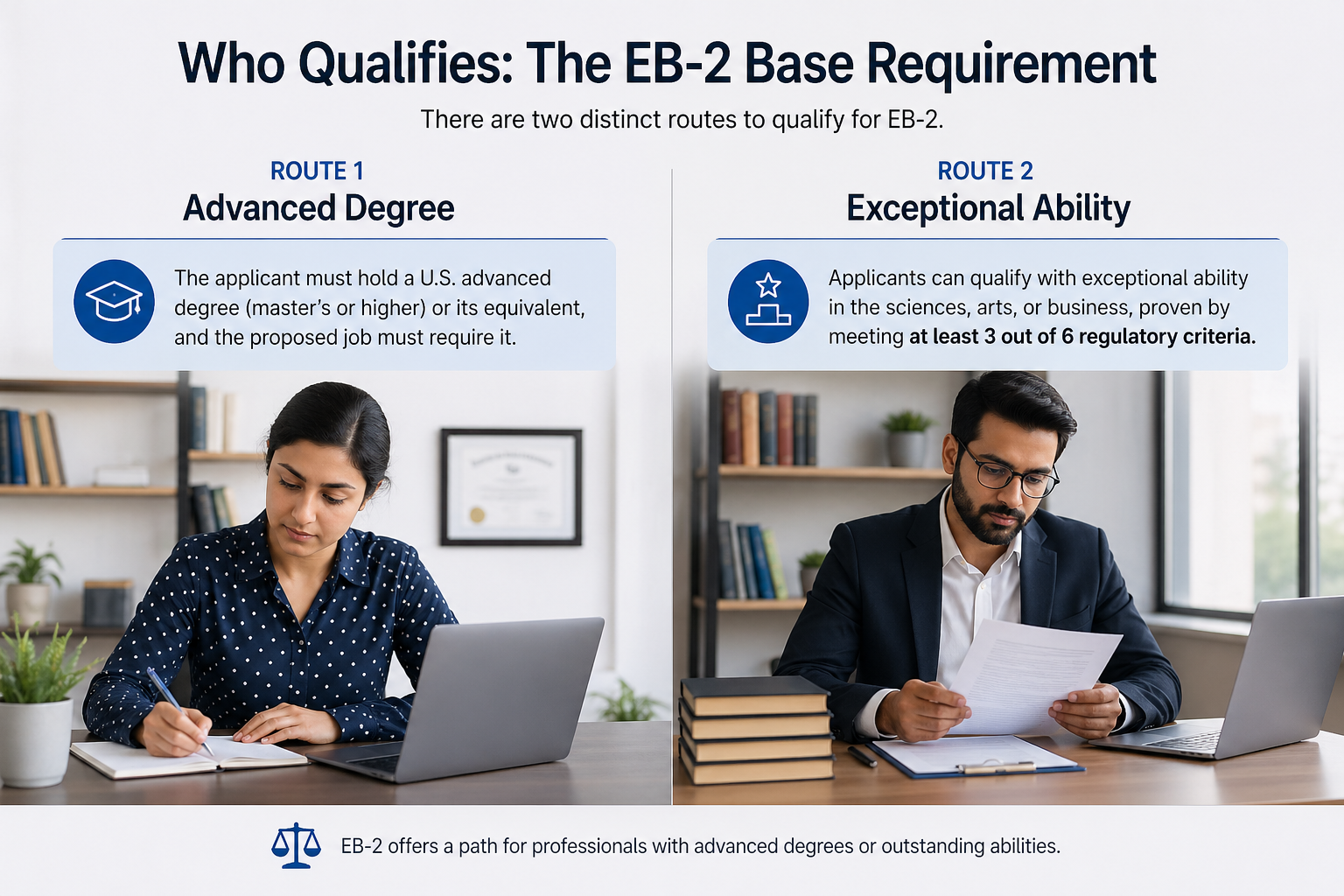
Before reaching the NIW analysis, a petitioner must first establish eligibility for the EB-2 Visa category itself. There are two distinct routes.
Route 1: Advanced Degree
The applicant must hold a U.S. advanced degree (master’s level or higher) or its foreign equivalent, and the proposed job must require an advanced degree. Foreign degrees must be evaluated by a NACES-member credential evaluation organization, and the evaluation must explicitly state U.S. degree equivalency.
A bachelor’s degree plus five years of progressive post-baccalaureate work experience in the specialty is treated as the equivalent of a master’s degree under USCIS policy. However, this equivalency must be explicitly demonstrated. A simple timeline showing years of employment is insufficient. The experience must be progressive increasing responsibility and expertise and directly in the specialty field.
Route 2: Exceptional Ability
Alternatively, applicants can qualify under the exceptional ability standard, defined as a degree of expertise significantly above that ordinarily encountered in the sciences, arts, or business (8 C.F.R. § 204.5(k)). USCIS evaluates exceptional ability through six regulatory criteria, of which at least three must be satisfied
| # | Criterion | Requirement (Refined Explanation) |
|---|---|---|
| 1 | Academic Qualification | An official academic record showing a degree, diploma, certificate, or similar award related to the applicant’s area of expertise |
| 2 | Professional Experience | Documentation demonstrating a minimum of 10 years of full-time experience in the relevant field, typically supported by employer-issued letters |
| 3 | Professional License or Certification | A valid license, certification, or authorization to practice the profession, where such credentials are required |
| 4 | High Salary or Remuneration | Evidence showing that the applicant has commanded a salary or compensation significantly higher than peers in the same field |
| 5 | Membership in Professional Associations | Membership in professional organizations that require demonstrated achievements or expertise for admission (not merely paid memberships) |
| 6 | Recognition for Achievements | Evidence of recognition for contributions to the field, such as awards, commendations, or acknowledgment from peers, organizations, or government entities |
The 2026 Processing Landscape: Timelines, Priority Dates, and Strategic Shifts
Understanding the current processing environment is essential before deciding when and how to file. Several developments have reshaped the EB-2 Visa landscape heading into 2026.
Current Processing Times
As of early 2026, standard EB-2 Visa I-140 processing times at the Texas Service Center which handles the majority of EB-2 Visa filings range from 8 to 14 months for regular processing. USCIS Premium Processing, which guarantees a substantive response (approval, RFE, or denial) within 45 business days, is available for I-140 petitions at a current fee of $2,805 under the fee schedule effective April 2024.
Processing times change frequently. Any published estimate should be cross-referenced against the current USCIS processing times.
Priority Dates and Visa Retrogression
Filing an approved I-140 does not immediately result in a green card. Applicants born in India or China face significant visa backlogs due to per-country annual limits on employment-based immigrant visas. As of early 2026, EB-2 Visa priority dates for India-born applicants are severely retrogressed the Visa Bulletin shows final action dates for India EB-2 Visa more than a decade behind the current date.
For applicants born in all other countries, EB-2 Visa dates are generally current or only slightly retrogressed, meaning the wait after I-140 approval is comparatively short. For India-born and China-born applicants, filing strategies including AC21 portability, concurrent I-485 filing when dates permit, and exploring EB-1A as an alternative become critically important to plan in advance.
Post-CHIPS Act Priority Fields
The CHIPS and Science Act (Public Law 117-167, signed August 2022) dramatically elevated the national importance of semiconductor research, quantum computing, artificial intelligence, and advanced manufacturing in USCIS adjudications. In practice, adjudicators have shown heightened receptivity to NIW petitions in these fields when the proposed endeavor is specifically aligned with CHIPS Act priorities particularly research into domestic semiconductor supply chain resilience.
Similarly, the NIH’s 2023–2027 Strategic Plan, the NSF’s 2022–2026 Strategic Plan, and the Department of Energy’s strategic vision for clean energy all function as explicit national importance frameworks that petitioners can reference directly in Prong 1 arguments.
Why Applications Fail: The Four Denial Patterns That Dominate
Analysis of USCIS denial notices and RFE responses across the EB-2 Visa category reveals four patterns that account for the majority of unfavorable outcomes. Understanding these is not optional background reading. It is the single most useful preparation a prospective petitioner can undertake.
Pattern 1: Vague Proposed Endeavor
Approximately 60% of EB-2 Visa RFEs cite inadequate definition of the proposed endeavor at Prong 1. The proposed endeavor must be specific: a named research program, business initiative, or specialist practice with articulated goals, methods, and national relevance not a general description of the applicant’s occupation.
The proposed endeavor is not a job title. It is not I will work as a software engineer at technology companies. It is a forward-looking, specific, nationally anchored program of work that only this applicant is positioned to advance.
Pattern 2: Generic Recommendation Letters
USCIS RFE notices routinely flag recommendation letters that speak to professional character rather than extraordinary positioning. The phrases “highly competent,” “dedicated professional,” and “strong collaborator” appear in thousands of letters and contribute nothing to a Prong 2 argument.
USCIS looks for independent experts not employers, co-authors, or direct collaborators who specifically address why this applicant, compared to peers, is uniquely positioned to advance the stated endeavor.
Pattern 3: Thin Citation Record or Non-Indexed Publications
Citation data is the single most objective measure of a researcher’s impact on their field. A petition asserting original contributions of major significance while presenting a Google Scholar profile with 20 self-citations and no independent citations will not satisfy Prong 2. Publications in predatory journals, non-indexed conference proceedings, or institutional reports carry minimal weight. USCIS adjudicators have access to Google Scholar and are trained to evaluate publication quality.
In fiscal year 2022, approximately 44% of I-140 petitions received an RFE, with the majority citing insufficient evidence of impact. While this figure spans all I-140 categories, EB-2 Visa petitions with weak evidentiary foundations disproportionately drive that statistic.
Pattern 4: Ignoring or Underselling Prong
As discussed earlier, Prong 3 is often treated as a formality. It is not. Petitions that fail to explicitly argue why the job offer waiver is warranted why this applicant cannot or should not be required to obtain employer sponsorship before contributing nationally important work leave the adjudicator without the legal basis to grant the waiver, even when Prongs 1 and 2 are satisfied.
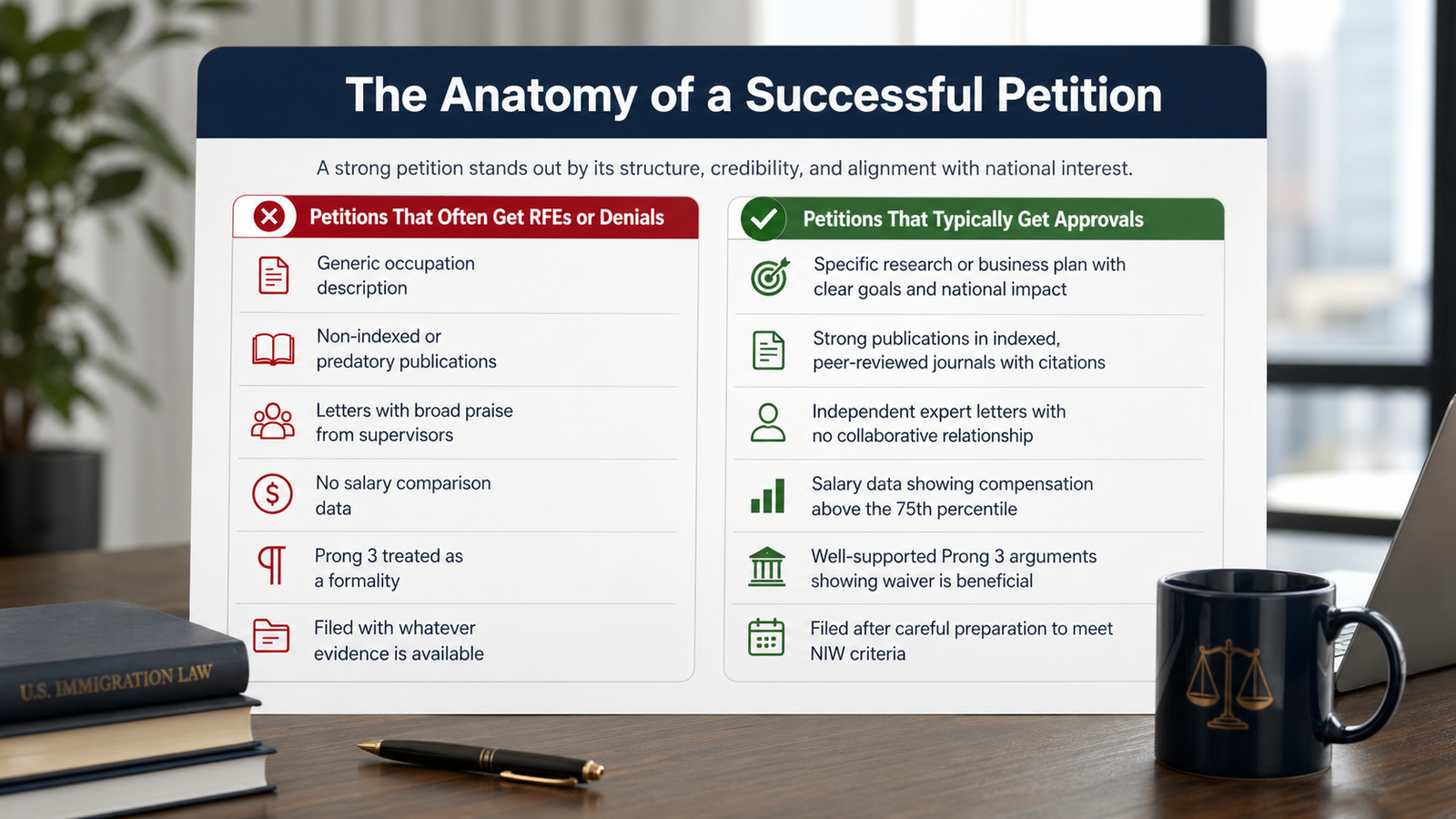
The Anatomy of a Successful Petition
A petition that succeeds at initial review without triggering an RFE shares structural characteristics that distinguish it from the majority of filings.
Petitions that generate RFEs or denials typically feature:
- A generic occupation description presented as the proposed endeavor
- Publications in predatory or non-indexed journals
- Letters from supervisors and collaborators offering broad praise
- No salary comparison data
- Prong 3 treated as a formality, often condensed into a single paragraph
- Filed with whatever evidence happens to be available today
Petitions that receive initial approvals typically feature:
- A named, specific research or business program with articulated goals and explicit alignment to national policy
- First-authored publications in indexed, peer-reviewed journals with independent citations (a minimum of 50+ independent citations is commonly recommended for researchers)
- Letters exclusively from independent experts with no collaborative relationship, who specifically compare the applicant to peers
- BLS Occupational Employment and Wage Statistics data plus field-specific salary surveys showing compensation above the 75th percentile for the occupation and geography
- A dedicated Prong 3 section with specific arguments for why the waiver is necessary and beneficial
- Filed after a deliberate preparation period designed specifically to satisfy NIW evidentiary criteria
The Profile Gap: Why Merit Alone Is Not Enough
The most important insight about EB-2 Visa failures is this: the majority of denials do not involve unqualified applicants. They involve qualified professionals who filed without the specific evidence architecture that the Dhanasar framework requires.
A mid-career engineer with 12 years of experience, three patents, and a strong professional reputation may be genuinely well positioned to advance a nationally important endeavor. But if those patents have never been cited by others, if there is no peer-reviewed publication record, if there is no media coverage of the work, and if the letters of recommendation come from direct supervisors rather than independent experts, the USCIS adjudicator has no objective evidence to evaluate.
This is the profile gap: the distance between a professional’s actual merit and the documented,independently verified evidence record that immigration adjudicators can evaluate. Closing this gap is not about manufacturing credentials. It is about ensuring that genuinely excellent work is captured, contextualized, and presented in a format that satisfies legal criteria.
The EB-2 NIW category requires a strong and well-documented case aligned with U.S. national interest. If you think you may be eligible, request a free assessment evaluation today and receive tailored guidance on your immigration options.
Frequently Asked Questions
Yes. The defining feature of the EB-2 National Interest Waiver is that it specifically waives the requirement for a job offer and employer-sponsored PERM labor certification. You file the I-140 petition yourself, based on your own qualifications and proposed endeavor, without any employer involvement.
USCIS does not publish category-specific approval rates in a single consolidated report, but analysis of quarterly data and attorney practice surveys suggests overall I-140 approval rates for EB-2 NIW petitions range from approximately 55% to 70% at initial review for well-documented cases. Petitions with significant evidence gaps face much higher RFE and denial rates, sometimes exceeding 50% at initial review. Premium processing affects speed only; it does not influence outcome.
No. The EB-2 Visa category requires either a U.S. advanced degree (master’s or higher), its foreign equivalent, or a bachelor’s degree plus five years of progressive post-baccalaureate work experience in the specialty. Alternatively, applicants can qualify under the exceptional ability standard without a specific degree requirement by satisfying at least three of the six regulatory criteria. Many successful EB-2 NIW petitioners hold master’s degrees or have demonstrated exceptional ability through professional achievement rather than doctoral credentials.
Standard processing at the Texas Service Center currently takes approximately 8 to 14 months. Premium Processing guarantees a substantive response within 45 business days for $2,805. After I-140 approval, the wait for a green card depends on country of birth. Most nationalities currently have current or near-current EB-2 priority dates. India-born and China-born applicants face multi-year backlogs. Always check the current USCIS Visa Bulletin at travel.state.gov.
Both are self-petition pathways requiring no employer sponsor, but they differ in standard and category. EB-1A (Extraordinary Ability) is a first-preference category with no per-country cap on annual visas, a higher evidentiary bar, and generally shorter wait times. EB-2 NIW is a second-preference category with per-country annual limits and a standard focused on national interest rather than extraordinary ability. For India-born and China-born applicants, EB-1A is often strategically preferable despite its higher bar. Both pathways can be pursued simultaneously.
Yes. Entrepreneurs, startup founders, and independent business professionals can qualify if their proposed endeavor meets the national importance standard and they are demonstrably well positioned to advance it. USCIS has approved NIW petitions for entrepreneurs in technology, healthcare, clean energy, and other nationally prioritized industries. The key is demonstrating national-level impact beyond the individual business job creation, industry innovation, or contribution to a documented national priority area.
A strong petition typically includes: (1) a specific, nationally anchored proposed endeavor tied to documented government priorities; (2) peer-reviewed publications in indexed journals with independent citations; (3) expert recommendation letters from independent authorities who explicitly compare the applicant to peers; (4) media coverage in recognized publications; (5) salary documentation with BLS or industry benchmark comparisons; (6) evidence of ongoing U.S.-based work or collaboration; and (7) a dedicated Prong 3 argument.
Yes. Filing an I-140 EB-2 NIW petition does not affect your nonimmigrant visa status. You can file while on H-1B, F-1 OPT, L-1, O-1, or most other nonimmigrant statuses. Once your I-140 is approved and a visa number is available, you can file Form I-485 to apply for your green card without leaving the United States.
Yes. Matter of Dhanasar explicitly clarified that national importance does not require affecting a large population. A highly specialized research program can satisfy national importance if it aligns with documented federal priorities or contributes to a broader nationally significant area. The burden is on the petitioner to make the connection explicit adjudicators will not assume national importance from a field description alone.
A Request for Evidence is not a denial. It is USCIS asking for additional documentation or clarification. You have 87 days to respond. The response must directly address every issue raised and provide the strongest possible additional evidence. Common RFE triggers include insufficient specificity in the proposed endeavor, generic recommendation letters, inadequate Prong 2 positioning, and weak Prong 3 arguments. A poorly handled RFE response can result in denial even when the underlying case is strong.