
What Makes the EB-1A Structurally Unique
The EB-1A, Employment-Based First Preference, Extraordinary Ability, differs from every other green card pathway in four ways that matter strategically:
| Feature | EB-1A Advantage |
|---|---|
| Preference category | EB-1A falls under the first preference employment-based category, which is generally faster than EB-2 and EB-3 for many applicants. |
| No employer required | The applicant may self-petition without an employer, job offer, or PERM labor certification. |
| Stronger visa-bulletin position | EB-1 usually has a more favorable visa-bulletin position than EB-2, although India and China may still experience retrogression depending on monthly visa availability. |
| No advanced degree required | EB-1A does not require a master’s degree, PhD, or specific academic qualification. Eligibility is based on extraordinary ability and documented achievements. |
| Broad professional scope | EB-1A is available in sciences, arts, education, business, and athletics, making it suitable for a wide range of high-achieving professionals. |
The no-per-country-backlog feature is the single most strategically significant advantage for India-born and China-born professionals. A qualified India-born applicant who files EB-1A today can realistically expect to receive a green card within two to three years. The same applicant on the EB-2 NIW India track faces a wait of fifteen to twenty-plus years at current Visa Bulletin progression rates. For many professionals, the higher evidentiary bar of EB-1A is not an obstacle it is the price of admission to a dramatically shorter queue.

The Legal Standard: What “Extraordinary Ability” Actually Means
The term is defined in 8 C.F.R. § 204.5(h)(2) as “a level of expertise indicating that the individual is one of that small percentage who has risen to the very top of the field of endeavor.”
This definition has generated more confusion than clarity. Professionals read “very top” and hear “best in the world.” They hear “Nobel laureate” or “Olympic gold medalist.” They hear celebrity. And they disqualify themselves before they have even examined the evidence.
The legal and practical standard is significantly more accessible than that interpretation implies. “Very top of the field” does not mean universally famous. It means recognized as elite among the people who actually understand your work your peers, your competitors, the institutions that evaluate contributions in your domain.
Since the landmark Ninth Circuit decision in Matter of Kazarian, 596 F.3d 1115 (9th Cir. 2010), USCIS has been required to apply a two-step adjudication framework:
Step 1: Threshold Met? Has the petitioner satisfied at least three of the ten regulatory criteria? This is a counting exercise but evidence quality matters even here. USCIS will not credit criteria satisfied by trivial or clearly self-serving evidence.
Step 2: Final Merits Determination. Even if three criteria are technically met, USCIS asks: does the totality of the evidence demonstrate that this person has risen to the very top of the field? This holistic review is where many strong-on-paper petitions collapse. Meeting three criteria by minimum margins does not automatically equal extraordinary ability.
The final merits determination is the hidden gate. A petition that barely clears three criteria one low-citation publication, one minor award, one peer review invitation can satisfy Step 1 and still be denied at Step 2 because the overall evidence does not paint the picture of someone who has genuinely risen to the summit of their profession.
The Ten EB-1A Criteria: What Works, What Fails, and What Adjudicators Actually See
Under 8 C.F.R. § 204.5(h)(3), USCIS evaluates extraordinary ability through ten regulatory criteria. At least three must be satisfied. The criteria cover a deliberately broad range, making the EB-1A accessible across sciences, business, arts, education, and athletics. What follows is how each criterion is applied in current USCIS adjudications not the theory, but the practice.
Criterion 1: Prize or Award of Excellence
What it requires: Nationally or internationally recognized prizes or awards for excellence in the field. The award must be genuinely competitive, judged by recognized experts, and specifically recognize excellence.
What works: Awards from prestigious professional bodies with documented selection criteria, named expert judges, and measurable competition pools. National or international scope. Evidence includes award certificates, press coverage of the award, and documentation of the selection process.
What fails: Company awards, employee recognition programs, participation trophies, regional competition wins, or awards from obscure organizations without documented selection criteria. Certificates of appreciation are not prizes for excellence.
Criterion 2: Membership in Associations Requiring Outstanding Achievement
What it requires: Membership in associations that require outstanding achievements as judged by recognized national or international experts. The membership must be selective on merit not open to all practitioners or available by paying dues.
What works: Fellow-level memberships in major professional societies (IEEE Fellow, ACM Fellow, Royal Society Fellow, AAAS Fellow). Invitation-only professional academies. Named boards or advisory committees with merit-based selection. Documented selection criteria and committee composition.
What fails: General IEEE or ACM membership, LinkedIn Premium, trade association memberships available to any practitioner, or paid memberships in non-selective organizations. USCIS adjudicators are trained to identify these distinctions.
Criterion 3: Published Material About the Applicant
What it requires: Published material in professional publications or major trade or mainstream media that specifically covers the applicant and their work. The publication must have significant distribution or professional standing. Coverage must be about the applicant’s contributions, not merely a quote in a broader story.
What works: Feature articles in nationally circulated trade publications, technology media (TechCrunch, MIT Technology Review, Science, Nature News), or mainstream news with strong professional readership. Each piece should center the applicant’s specific work and name them as the primary subject.
What fails: Local newspaper mentions, company blog posts, social media posts, or articles in which the applicant is one of many sources quoted. Press releases issued by the applicant’s own employer carry no evidentiary weight.
Criterion 4: Judging the Work of Others
What it requires: Participation as a judge of the work of others in the same or allied field, either individually or as part of a panel. Peer review for scholarly journals, grant application review for funding bodies, competition judging, and dissertation committee membership all qualify.
What works: Documented invitations to serve as peer reviewer for indexed journals (Publons or Web of Science reviewer profiles are strong evidence), grant panel service (NIH, NSF, EU Horizon), or competition judging at professional events with named expert panels. Include invitation letters and review confirmation emails.
What fails: Informal code review at work, internal committee membership, or undocumented review invitations with no paper trail. One-time ad hoc reviews with no evidence of why the applicant was selected.
Criterion 5: Original Contributions of Major Significance
What it requires: Original scientific, scholarly, artistic, athletic, or business-related contributions that have been adopted or applied by others and have had a major impact on the field. USCIS looks for objective evidence that the contribution influenced the field beyond the applicant’s own work.
What works: Independent citations by other researchers who built upon the applicant’s methodology, findings, or framework. Third-party adoption of a technology, protocol, or approach in industry or practice. Expert letters from authorities not affiliated with the applicant describing specific influence on the field.
What fails: Self-citation or co-author citation only. Describing contributions in narrative form without third-party evidence of adoption or influence. Contributions that were important within one employer’s operations but have had no documented field-level impact.
Criterion 6: Authorship of Scholarly Articles
What it requires: Authorship of scholarly articles in professional journals or major media in the field. USCIS evaluates publication quality (indexed journals, impact factor), authorship role (first or corresponding author weighted more heavily), and citation impact.
What works: First or corresponding author publications in indexed, peer-reviewed journals. Publications in journals with documented impact factors and recognized editorial boards. Articles that have generated independent citations. Include Google Scholar or Web of Science citation data with the petition.
What fails: Publications in predatory journals, pay-to-publish outlets, or conference proceedings with minimal peer review. Articles in which the applicant is listed last in a long author chain with no named corresponding author role. Uncited papers that show no evidence of field influence.
Criterion 7: Display of Work at Artistic Exhibitions or Showcases
What it requires: Display of the applicant’s work in the artistic field at exhibitions or showcases with significant professional recognition. This criterion is specifically designed for artists, designers, architects, and creative professionals.
What works: Exhibitions at nationally or internationally recognized institutions (major museums, design weeks, architectural biennales). Named juried shows with documented selection criteria. Commercial gallery representation in established markets. Include exhibition catalogs, attendance documentation, and critical reviews.
What fails: Local gallery shows, community arts events, employee art shows, or digital displays on personal websites. Exhibitions without documentation of audience, venue standing, or selection criteria.
Criterion 8: Critical or Essential Role in Distinguished Organizations
What it requires: Performance of a critical or essential role for organizations or establishments with a distinguished reputation in the field. Distinguished means recognized as outstanding not merely large, profitable, or well-known to the general public.
What works: Documented evidence of specific, measurable impact on a distinguished organization’s outcomes. Independent expert testimony about the criticality of the role. Organizational rankings, awards, and recognition establishing the entity’s distinguished status. Revenue impact, product launches, or institutional outcomes directly attributable to the applicant.
What fails: Employment letters that assert the applicant is “critical” without evidence of what would have changed without them. Job titles such as “Senior Director” without documentation of specific critical impact. Large but undistinguished employers a big company is not automatically distinguished in its field.
Criterion 9: High Salary or High Remuneration
What it requires: A high salary or other remuneration for services significantly higher than that paid to others in the field. USCIS compares against published industry salary data for the specific occupation, experience level, and geography.
What works: Salary documentation compared against BLS Occupational Employment and Wage Statistics (OES), industry salary surveys (Robert Half, Levels.fyi for technology, MGMA for physicians), and expert letters from compensation specialists. Total compensation including equity, bonuses, and benefits, valued and documented.
What fails: Pay stubs without comparative data, comparison against national averages rather than occupation-specific benchmarks, or inclusion of perks (travel allowances, meal vouchers) that are not genuine compensation. High salary in one market presented without geographic adjustment.
Criterion 10: Commercial Success in the Performing Arts
What it requires: Commercial success in the performing arts, measured by box office receipts, recording sales, viewership data, or other industry-standard commercial measures. This criterion is specific to performing artists and entertainers.
What works: Documented revenue data from performances, recordings, or productions. Distribution metrics for films, music, or digital content. Named commercial credits in productions with documented commercial performance. Comparisons against industry benchmarks for the specific performing arts sector.
What fails: Social media followers, streaming play counts on free platforms, or commercial participation in productions with no documented revenue data. Self-produced content without commercial distribution or revenue.
Strategic Criterion Selection: Which Three to Build and Why
Choosing which criteria to pursue is one of the most consequential strategic decisions in an EB-1A case. Not all criteria are equally achievable for all professionals, and not all combinations carry equal weight in the final merits determination. Immigration practitioners who specialize in EB-1A cases consistently identify three criterion clusters that produce the highest approval rates for different professional profiles:
| Profile Type | Strongest Criterion Combination | Why It Works |
|---|---|---|
| Researcher / Academic | Scholarly Articles (6) + Original Contributions (5) + Judging (4) + Published Material About the Applicant (3) | A strong citation record establishes measurable impact. Invitations to review or judge confirm recognition by independent experts. Third-party media or publications reinforce broader significance beyond academia. |
| Business / Technology Professional | Critical Role (8) + High Salary (9) + Original Contributions (5) + Judging (4) or Selective Memberships (2) | Demonstrates leadership within distinguished organizations, supported by quantifiable business outcomes. High compensation validates market value, while contributions and peer recognition establish influence beyond a single employer. |
| Creative / Arts / Design Professional | Published Material About the Applicant (3) + Display of Work (7) + Awards or Prizes (1) + Critical Role (8) | Independent reviews, exhibitions, and awards build a strong public and institutional record. Leadership roles in reputable organizations further validate standing within the field. |
| Interdisciplinary / Entrepreneur | Original Contributions (5) + Published Material (3) + Critical Role (8) + (case-specific supporting criterion) | These profiles are best positioned by combining innovation, media recognition, and leadership in ventures. Flexibility is key—criteria must be tailored to demonstrate sustained impact across domains. |
Current EB-1A Processing in 2026: Timelines, Fees, and the India Backlog Strategy
As of early 2026, standard EB-1A I-140 processing times at the Nebraska Service Center which handles the majority of EB-1A filings range from 10 to 18 months for regular processing. Premium Processing, which guarantees a substantive response (approval, RFE, or denial) within 45 business days, is available at the current fee of $2,805 under the USCIS fee schedule effective April 1, 2024.
For India-born applicants, the EB-1 priority date as of early 2026 is current or minimally retrogressed meaning there is effectively no wait between I-140 approval and green card filing eligibility for most India-born EB-1A petitioners. This stands in stark contrast to the EB-2 India track, where the final action date is more than a decade behind. For professionals born in India who can satisfy the EB-1A standard, the category is not merely an alternative to EB-2 NIW. It is strategically superior in almost every meaningful dimension. Priority date information changes monthly. Always verify current dates at the U.S. Department of State Visa Bulletin.
EB-1A vs. EB-2 NIW: Which Pathway Is Right for You?
Many professionals are potentially eligible for both categories. Understanding how to choose or whether to file both simultaneously is one of the most important strategic decisions in the self-petition process.
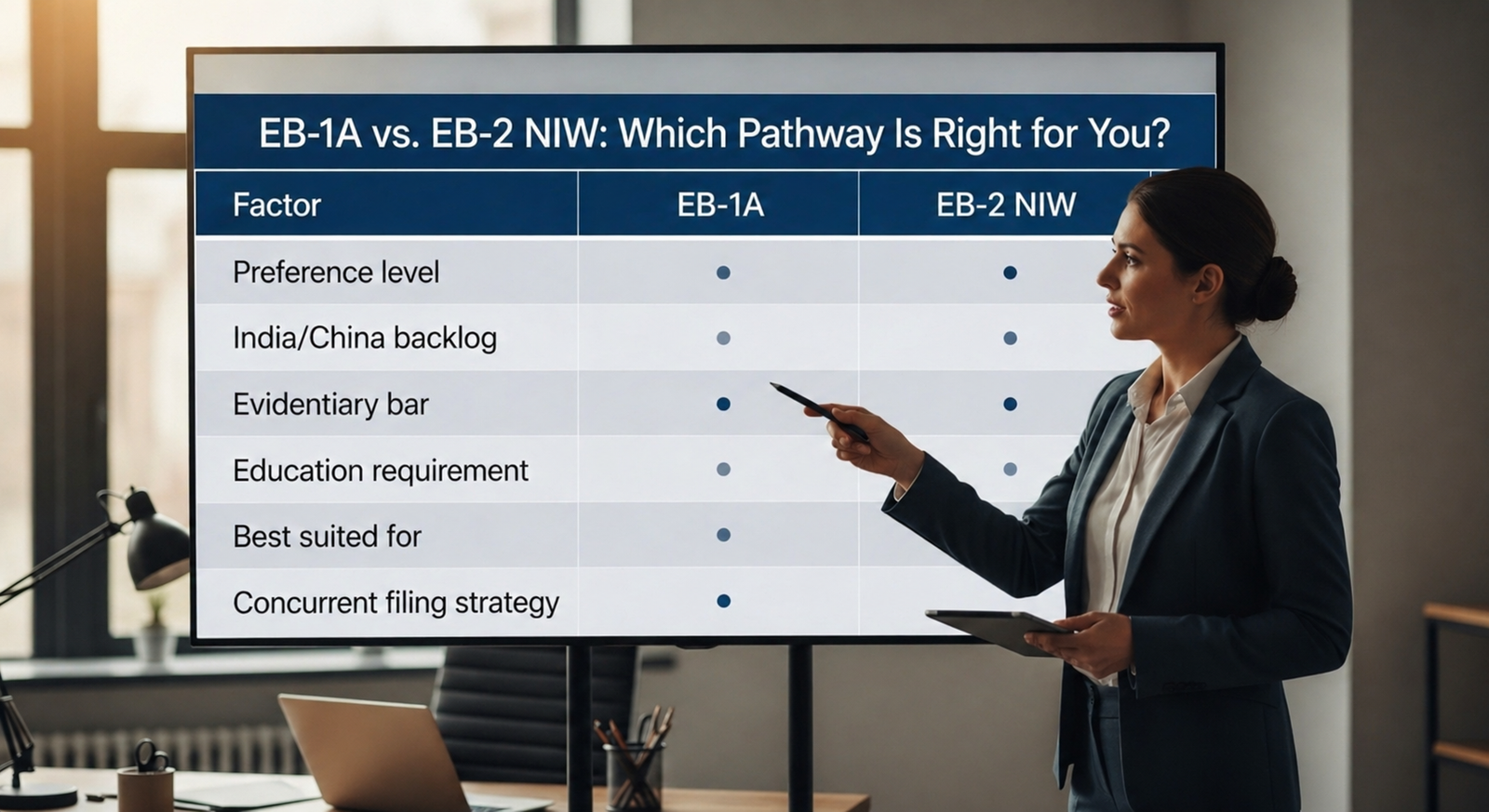
| Factor | EB-1A | EB-2 NIW |
|---|---|---|
| Preference level | First preference (EB-1), generally faster movement in the visa bulletin compared to EB-2 | Second preference (EB-2), subject to higher demand and longer waiting times for certain countries |
| India/China backlog | Typically more favorable than EB-2, but may still experience periodic retrogression depending on visa demand | Significantly backlogged for India and China, with long waiting periods due to high demand |
| Evidentiary bar | Higher standard—must demonstrate extraordinary ability and sustained national or international acclaim | More flexible standard—requires showing national importance and that the applicant is well-positioned to advance the proposed endeavor |
| Education requirement | No minimum degree requirement; entirely achievement-based | Requires an advanced degree or proof of exceptional ability |
| Best suited for | Individuals with strong, verifiable recognition (e.g., publications, awards, leadership, media coverage) placing them at the top of their field | Professionals whose work has clear national importance and practical impact, supported by a strong proposed endeavor |
| Concurrent filing strategy | Can be filed independently or alongside EB-2 NIW as part of a dual-track strategy | Can be filed in parallel with EB-1A to maximize approval and timing flexibility |
Dual-filing is particularly valuable for India-born and China-born applicants. The petitions are evaluated independently. An approval on one does not affect the other. An RFE on one does not prejudice the other. If EB-1A is approved, the applicant benefits from superior visa availability. If EB-1A encounters difficulty, the EB-2 NIW petition provides a fallback.
Why the Evidence Architecture Matters More Than the Standard Itself
The most important insight from years of EB-1A petition analysis is this: the majority of denied petitions involve applicants who had the underlying merit to qualify. What they lacked was the documented, externally validated, adjudicator-readable evidence record that converts genuine extraordinary ability into an approvable petition.
Meeting three criteria on paper is not the same as building a case that demonstrates someone who has risen to the very top of their field. The final merits determination asks: does this person’s evidence, taken as a whole, paint that picture? A scattered set of minimum-threshold evidence items does not paint that picture. A coherent, well-documented record of impact, recognition, and peer acknowledgment does.
The professionals who file successful EB-1A petitions particularly at initial review without RFEs almost universally share one characteristic: they spent 12 to 24 months before filing deliberately constructing the specific evidence types that USCIS needs to see. Publications aligned with their field’s leading journals. Media coverage generated from those publications. Peer review invitations earned through the visibility that indexed publications create. Award applications submitted to competitions where their accumulated record made them competitive. Letters of recommendation solicited from independent experts who knew their work because of the professional footprint they had built.
This is not about manufacturing credentials. It is about ensuring that genuinely excellent work is captured, contextualized, and presented in a format that satisfies legal criteria.
The EB-1A visa is highly competitive and requires a strong, well-documented case. If you think you may be eligible, take the next step today by requesting a free assessment. Our immigration experts will review your profile and guide you through your best possible pathway toward approval.
Frequently Asked Question (FAQ)
No. The legal standard established in 8 C.F.R. § 204.5(h)(2) is that you must be among the small percentage who has risen to the very top of your field. This does not mean the best in the world. It means demonstrably at the top of your field through objective evidence: sustained recognition, significant citations, peer acknowledgment, notable awards, and documented influence. Many mid-career and senior professionals who have built consistent, recognized track records qualify without any globally famous achievements.
A minimum of three out of ten regulatory criteria must be met to clear the Step 1 threshold. However, satisfying exactly three criteria by minimum margins often leads to denial at Step 2 the final merits determination because USCIS evaluates the totality of evidence holistically. The strongest petitions typically satisfy four or five criteria with deep, multi-layered evidence and present a coherent narrative of extraordinary ability across the entire case.
Technically yes USCIS permits self-represented petitioners. Practically, EB-1A is among the most complex petition types in U.S. immigration law, and the final merits determination requires legal argumentation that non-attorneys typically find difficult to frame correctly. The 50–60% initial approval rate includes many attorney-prepared petitions; pro se petitions have notably higher denial and RFE rates. Given that an EB-1A denial can affect future filing strategy and priority dates, working with an experienced EB-1A immigration attorney is strongly recommended.
Standard processing at the Nebraska Service Center currently runs approximately 10 to 18 months. Premium Processing guarantees a substantive response within 45 business days for $2,805. Always verify current processing times at check.uscis.gov and confirm the current premium processing fee at uscis.gov/forms/filing-fees before filing.
Significantly so. As of early 2026, the EB-1 priority date for India-born applicants is current or minimally retrogressed, while the EB-2 India priority date is more than a decade behind. An India-born professional who qualifies for EB-1A can realistically obtain a green card within two to four years. The same applicant in the EB-2 NIW India backlog could wait 15 to 20-plus years. For India-born professionals close to the EB-1A threshold, the investment in meeting that standard is almost always worth making.
Yes. Filing both petitions simultaneously is valid and relatively common, particularly for India-born and China-born applicants. The two petitions are evaluated independently. An approval on one does not affect the other, and an RFE on one does not prejudice the other. The attorney preparing both petitions should ensure the evidence packages are complementary and that the EB-1A narrative does not inadvertently undercut the EB-2 NIW case.
No. EB-1A is a self-petition category. No employer involvement, no job offer, and no PERM labor certification are required at any stage. The petition is filed based solely on the applicant’s own qualifications. This also means the petition is portable if you change employers, start your own business, or pursue independent work, the petition and any accumulated priority date remain intact.
Both require extraordinary ability, but they serve different purposes. The O-1A is a temporary nonimmigrant work visa it allows you to live and work in the U.S. but does not lead directly to permanent residency. The EB-1A is a permanent resident (green card) petition. The evidentiary standard is similar, but EB-1A is evaluated to a higher threshold at the final merits determination stage. Having an approved O-1A does not guarantee EB-1A approval, but O-1A approval is frequently cited as persuasive precedent. Many professionals use the O-1A period strategically to build additional evidence that elevates their case to EB-1A standard.
An EB-1A denial is not permanent. Options include: (1) filing a motion to reconsider or motion to reopen with USCIS if there was a clear legal error; (2) appealing to the Administrative Appeals Office; (3) refiling with substantially stronger evidence; or (4) pivoting to an EB-2 NIW petition if the profile supports that standard. The most important step after a denial is careful analysis of the denial notice understanding exactly which criteria USCIS found insufficient and why determines the correct strategic response.
Start with an honest self-assessment against the ten criteria. Can you identify at least three where you have strong, documented, externally validated evidence? Not achievements you remember evidence that exists on paper, is independently attested, and meets the specific USCIS standard for each criterion. If the answer is unclear, a professional evaluation against current adjudication standards can provide clarity before you commit to any filing strategy